




The Green Sheet Online Edition
July 13, 2026 • 26:07:01
Agentic payments - Should you be worried?
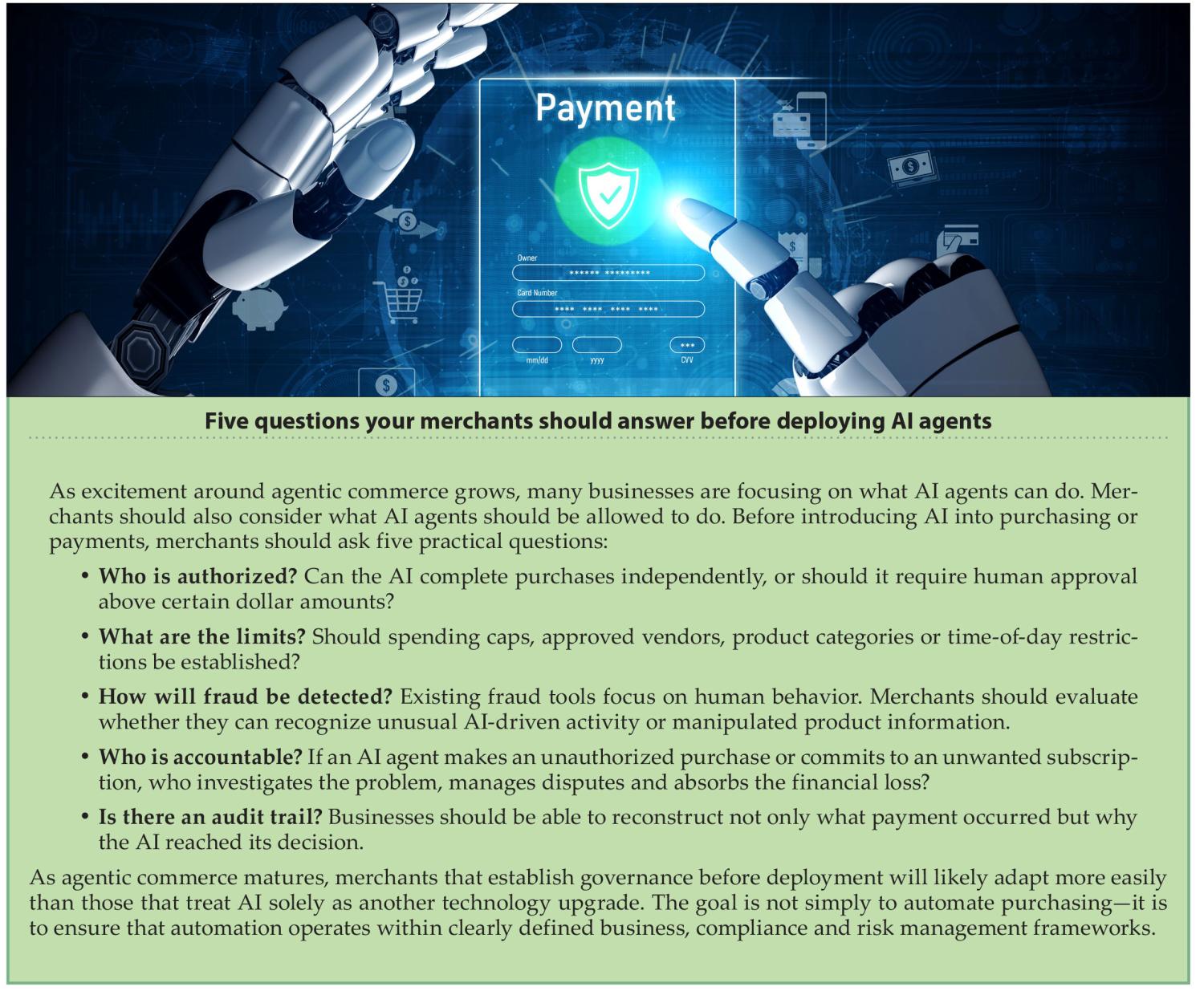
AI is this year's buzzword. Everybody is talking about autonomous agents who will be shopping on our behalf: finding the best deals, completing the checkout and even authorizing payments, all without human intervention. But where does the payer's responsibility end and the AI's start? Who should take the financial hit if something goes wrong?
Are we going to see a brand-new chargeback category: "My AI did this"?
Against all the excitement, agentic payments are an entirely new category of risk that no one is prepared for. The current payment and banking infrastructure was not designed to handle certain elements of this new technology. Moreover, those who manage payment and banking tasks are not adequately trained to do so.
Key areas such as how payments and banking affect technology, UX, compliance and other essential aspects of a business are absent from accounting and economics courses, as well as MBA programs. This means the people who manage payment- and banking-related tasks are already working in a blur and now also have to master this lesser-known, brand-new area they have never seen before.
So how can businesses make sure they are taking advantage of the opportunity instead of losing momentum?
Responsibility
One of the biggest unanswered questions in agentic payments is responsibility. The entire payment ecosystem, from card schemes and banks to payment providers and regulators, was designed around a simple assumption: a human makes a decision, authorizes a transaction and accepts the consequences of that decision. Agentic payments challenge that assumption entirely.
When an AI agent purchases the wrong product, who is responsible? If it misunderstands the user's instructions and spends more than intended, who carries the financial loss? And what about manipulation, fraud or misleading information?
This creates an entirely new layer of uncertainty for dispute management.
The situation becomes even more complicated when multiple AI agents begin interacting with each other. One AI may represent the consumer while another represents the merchant. Both systems may negotiate prices, delivery terms, subscriptions or recurring commitments before payment is initiated. If a misunderstanding occurs between two autonomous systems, determining responsibility becomes significantly more difficult than identifying which human made a mistake.
New controls
Payment providers and acquiring banks will inevitably face pressure to introduce new controls. They will need to determine the level of authority an AI agent possesses, and also how instructions should be verified after the transaction takes place. The industry may eventually require completely new audit trails that capture not only the payment itself but also the reasoning process that led to the payment decision.
Regulators will face similar challenges. Existing payment regulations assume that decision-making originates from an identifiable person or organization, but agentic payments introduce a third participant into the relationship.
The AI is neither a customer nor a regulated financial institution, but it can easily influence decisions that move significant amounts of money. This creates difficult questions regarding accountability, consumer protection, transparency and oversight.
Fraud
Today's fraud monitoring systems are designed around human behavior: analyzing spending patterns, locations, devices and transaction history to determine whether a payment appears legitimate.
Agentic payments change this dynamic entirely. AI agents may search hundreds of websites, interact with multiple merchants simultaneously and complete transactions at a speed no human can match. Fraudsters will quickly adapt to this new environment, and they will manipulate AI agents through fake websites, misleading product information, fraudulent offers or artificially generated reviews designed to influence purchasing decisions.
An AI agent may identify the cheapest option available, but that does not mean it has identified the safest one. As a result, fraud prevention will no longer focus only on verifying the identity of the payer, but also increasingly on verifying whether the information and decisions used by the AI can be trusted.
You're not ready for agentic AI
Most businesses do not even have a payment and banking strategy today. They work with various payment providers, bank accounts, gateways, fraud tools and internal procedures, but these components usually operate independently from each other. No single person oversees the whole process, let alone makes informed decisions about the latest innovations and risks associated with payment and banking flows.
Agentic payments introduce a completely new layer of decision-making that affects every area of an organization: customer experience, risk management, technology, product development, data security, compliance, finance, sales and growth, and more. Payment and banking must be a standalone function, an essential element of the business strategy, not just a part of finance. Adding an AI agent will only complicate this.
When a company designs an AI agent from a technology perspective, it will most definitely ignore the interdependencies and will create compliance concerns, fraud exposure, operational issues, or financial losses elsewhere in the organization.
Before businesses can safely adopt agentic payments, they must first understand how money moves through their organization and how payment and banking decisions affect every other function within it. Otherwise, they risk introducing a powerful new technology into a system that is already struggling to manage the risks of the old one.
How to prepare before it is too late
The mistake most businesses will make is assuming that agentic payments are purely a technology project. They are not. They are a payment and banking project, a compliance project, a fraud project, a customer experience project and a risk management project all at the same time.
Before deploying AI agents, businesses must first understand who will be responsible for decisions, how authority will be delegated, which controls will be applied and how disputes will be resolved when things go wrong. They must review their payment flows, banking relationships, fraud controls, terms and conditions, customer communication, and internal governance structures.
Most importantly, they must educate the people responsible for managing payment and banking tasks, because technology alone will not solve these challenges. Interestingly, the companies that will succeed with agentic payments will not necessarily be the ones with the most advanced AI, but the ones that recognize payment and banking as a standalone business function. Payment and banking decisions need to be made by dedicated decision-makers with the knowledge and skills to manage its risks, opportunities and impact across the organization.
The future
Agentic payments are coming whether businesses are ready or not. The question is whether organizations understand the implications and interdependencies before adoption takes place.
The future will require new governance models, and most importantly, new skills. Education will become one of the most important competitive advantages, because the professionals responsible for payment and banking decisions will need to understand not only technology, but also risk, compliance, fraud, customer experience and operational impact.
This is precisely why the Chief Payment Officer role is emerging. The CPayO is responsible for understanding how money moves through an organization and how payment and banking decisions impact every area of the organization. As AI agents become increasingly involved in financial decision-making, businesses will need a dedicated specialist who can connect these functions, oversee the risks and ensure that innovation creates value rather than introducing costly operational, compliance and financial problems.
But without proper education, businesses will continue to make payment and banking decisions based on assumptions or advice from their suppliers—whose interests likely do not align with their own.
Understanding how payments and banking affect every function within an organization will become one of the most valuable skills in the age of agentic AI, because the companies that understand these interdependencies will be in a far stronger position to manage risk while taking advantage of innovation. 
Viktoria Soltesz is the CEO and founder of PSP Angels and The Soltesz Institute. She is a leading advocate for strategy-led financial operations, ethical industry practices, and structured education in an area too often overlooked in traditional business training. PSP Angels is a globally awarded, independent payment and banking consultancy that has supported over 1,000 companies in building scalable, secure financial infrastructures. The Soltesz Institute is the first and only independent online organization offering EU-accredited training and certifications focused exclusively on payments and banking. To contact Viktoria, please email viktoria@pspangels.com.
Notice to readers: These are archived articles. Contact information, links and other details may be out of date. We regret any inconvenience.
