




The Green Sheet Online Edition
February 23, 2026 • 26:02:02
Day 365 test: Why ISV payment processor decisions fail
Marriage can be hard. It's not just about tomorrow or the honeymoon phase; it's about the long arc … 'til death do us part. Courting, by comparison, is easy. Nobody is late on their first date. Expectations are managed, best behavior is on display and optimism is high. So it often goes with contractual relationships in payments.
Everything works in the demo. Corner cases can be accommodated. New features are "pending QA." Economics are modeled, terms agreed to, and high-fives are exchanged as the contract is signed. For a brief period, you're riding the contract-signing high. Your RFP rubric was thoughtful, detailed and quantitative.
Unfortunately, contract signings don't pay the bills. Day 365 may look nothing like your Day 1 expectations.
This reality is especially acute for independent software vendors (ISVs), where payments decisions become deeply embedded into product architecture and are costly, disruptive and sometimes impossible to unwind.
#h2The demo problem Unlike a new car, integrated payments solutions are difficult to test drive. Some degree of integration is required before meaningful comparison is possible, and by the time that work is complete, you're often already committed. Processor contracts are frequently regretted because of a mismatch between expectations, capabilities and delivery.
Further, processors change their business models in the face of revenue shortfalls or complex market forces. Some of these changes negatively impact ISVs.
Processors, understandably, are incentivized to close deals. ISVs, meanwhile, are making decisions that will shape their long-term strategy, GTM positioning, product roadmap and customer experience. To mitigate this risk, many teams rely on weighted evaluation rubrics to introduce objectivity into the selection process.
The comfort — and illusion — of the rubric
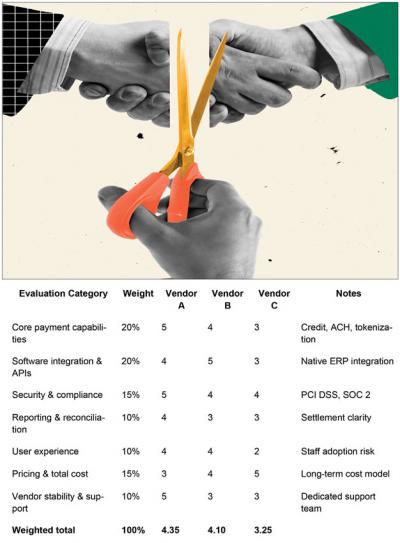
(See attached graphic for details) Based on this rubric, Vendor A is selected. The pen is dropped. The deal is done. But if the weighting shifts slightly, a different vendor wins. One could reasonably argue that security and compliance should be pass/fail, not weighted.
Others might ask why there is no scoring for roadmap credibility, release frequency, pace of innovation or integration partnership quality. Without deeper vetting and comparison, the rubric provides numerical confidence without operational certainty.
And yet, this is how some of the most consequential payments decisions are made, which explains the prevalence of buyer's remorse.
The ISV knowledge gap
Most ISVs do not have deep payments expertise in-house. Payments are rarely their core product. This article is not meant to catalog every consideration an ISV must evaluate, but it's important to recognize the scope. For card-present environments, ISVs must evaluate both software integration and hardware strategy. That single decision radically expands compliance obligations, support needs, and long-term risk.
ISVs must assess which decisions are reversible, which are not, and whether a prospective partner can operate within, rather than constrain, existing development choices.
Pricing is important—and often misleading
Pricing is always critical, but it is also the most over-indexed metric because it is the easiest to compare. Numbers feel objective. Payments professionals like numbers. Do not be fooled by sticker price alone. True cost includes:
- Internal staffing and escalation burden
- Vendor replacement risk
- Constraints on future product innovation
- Long-term pricing adjustments and margin compression
- These costs rarely surface in demos and seldom appear in RFPs.
A better way to evaluate
Before engaging a processor, ISVs should conduct a rigorous self-assessment. Understand your own assets and liabilities so you can identify a partner that truly meshes with your needs. Understand your competition and relative gaps. Define clearly what you expect to build in-house versus what you expect a partner to deliver. Map geographic expansion plans and identify emerging features that may be strategically important.
Define what successful implementation actually looks like, and be prepared to manage the internal change required to support it.
Speak with existing processor clients. Validate integration commitments. Understand reputation, corporate structure, and how those factors influence future investment, pricing escalation and support. Review release notes, updates, frequency of releases and compatibility. You can learn a lot from the past, and though it's not a guarantee of future performance, it is a highly correlated predictor.
The Day 365 perspective
Processor decisions are heavy and long-lasting. They shape economics, product flexibility, customer experience and organizational velocity. For ISVs, few decisions carry more strategic weight. Getting it right requires more than a polished demo or a well-weighted rubric. It requires a clear Day 365 perspective, grounded operational insight, and the humility to recognize what you do not yet know.
If you don't have that perspective in-house, borrow it, before signing.
As founder of Humboldt Merchant Services, co-founder of Eureka Payments, and a former executive for such payments innovators as WePay, a division of JPMorgan Chase, Ken Musante has experience in all aspects of successful ISO building. He currently provides consulting services and expert witness testimony as founder of Napa Payments and Consulting, www.napapaymentsandconsulting.com. Contact him at kenm@napapaymentsandconsulting.com, 707-601-7656 or www.linkedin.com/in/ken-musante-us.
Notice to readers: These are archived articles. Contact information, links and other details may be out of date. We regret any inconvenience.
