




The Green Sheet Online Edition
November 23, 2026 • 26:11:02
What to expect from your payment gateway when payments fail under DORA
It's been almost two years since the Digital Operational Resilience Act (DORA) became applicable across the EU, and regulators are starting to see errors in the reporting process. On Sept. 16, 2026, the European Supervisory Authorities (ESAs) published new operational instructions for regulators handling major ICT-related incident reports under DORA, aiming to improve the quality and consistency of reporting across jurisdictions..
Some details that firms must report are standard: what stopped working, the timeframe of the issue, the cause, if or what suppliers were involved. This alone takes time to break down when a transaction has passed through several providers.
The ESAs say incidents that began at a third-party provider have been difficult to report and analyze. Anyone who has worked in payments will recognize that, because each link in the chain works in silos, each provider sees only its own part of a transaction.
A fall in approval rates could sit with the gateway, an acquirer, another provider further down the chain or an external outage. Fraud activity can cloud the picture as well; if all you can see is a decline in approvals, the issue still needs thoroughly investigating. I'd argue the gateway should do the drudgery for you. The first annual DORA incident report, which came out in June 2026, covered 3,383 major ICT-related incidents reported across the EU financial sector in 2025.
Payments made up 16 percent of the total and almost one in three incidents started with a third-party failure (see tinyurl.com/bdsbdmzt).
Where delays start
When a third party is involved, the reporting firm can be dealing with the effects of a problem while information is still coming back through the payment chain. Payments teams are used to this. They might have approval data in one place, fraud information elsewhere and provider updates arriving separately.
With card payments, every approval and decline comes back through the gateway, so when several providers are in the mix, you can start to see when one is behaving differently from the rest.
This is one reason LLM technology is being integrated into payment gateways: it can surface payment-performance insights and fraud signals in seconds. We've been exploring this capability in our own gateway. It helps teams investigate what happened and understand what it means, starting from the underlying payment data rather than a headline approval rate.
If approvals dipped on Tuesday, the payments team will want to know when it started, how many transactions were involved and what was happening across different providers, and compliance may need that same information for a DORA report. Where an incident started with a supplier, DORA also asks for that provider to be identified by its legal name and identification code.
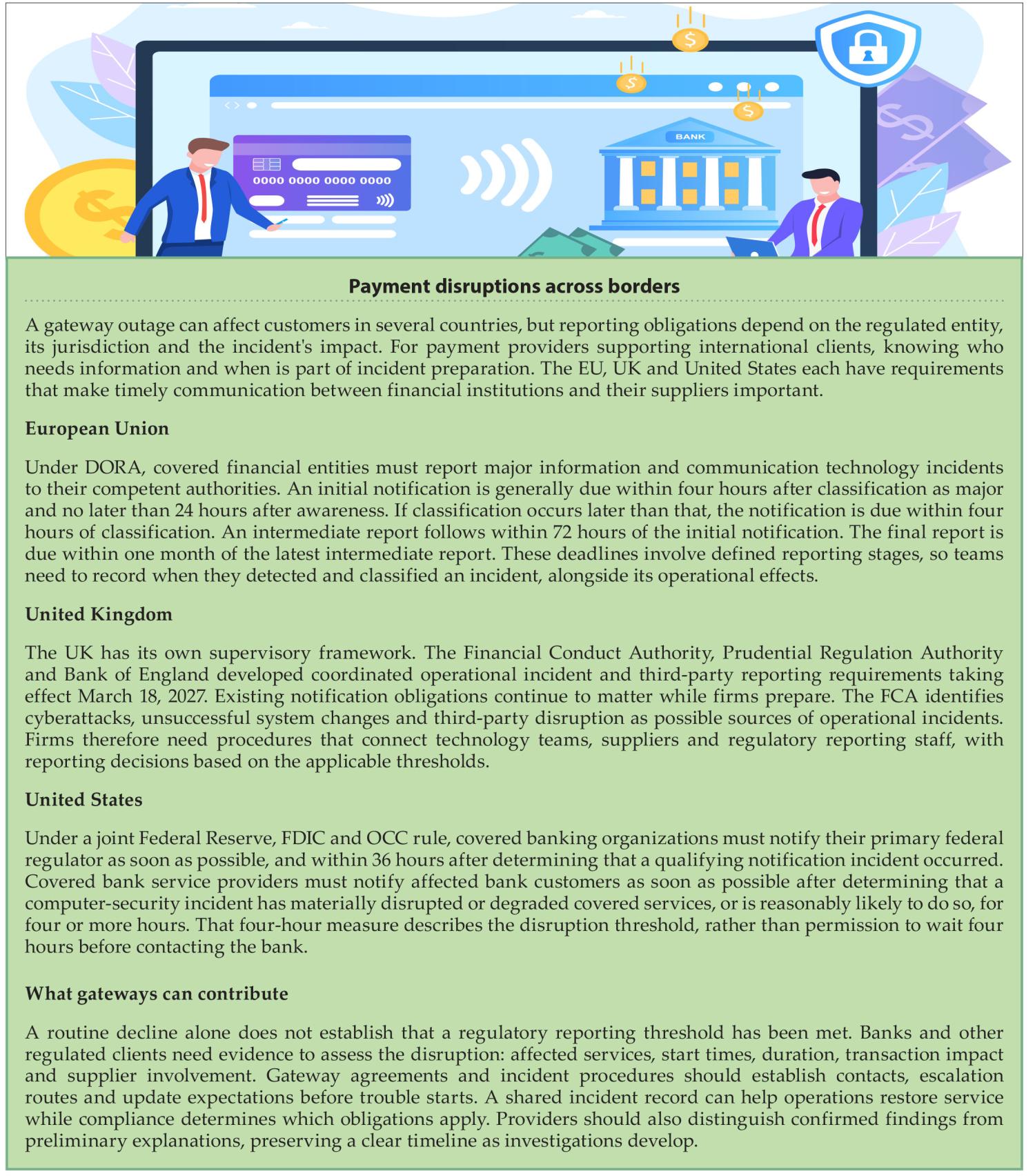
An initial notification can be due within four hours of an incident being classified as major, with an intermediate report due within 72 hours of the initial notification.
Questions to ask your gateway
Rising declines can either come from fraud rules or a fault somewhere further along the chain. From the outside both can look similar. You need enough detail to work out which one you're dealing with before you start changing anything.
According to the June report, around 40 percent of companies put no direct or indirect costs against their incidents in 2025, and another 15 percent left the field blank. The ESAs point out that staff time spent dealing with an incident should be included, and in payments you can't really start putting a figure on an outage without knowing how many transactions were hit and for how long.
If I were choosing a gateway or coming up for renewal, I'd want to know how quickly it could show me when approvals started to fall and which providers were involved, how many transactions were affected over what period, and what it could show me about fraud-related declines versus technical ones.
If an incident began with a supplier, can the gateway provide that supplier's legal name and identification code? When somebody later has to work out what the outage cost, how much of the information is already there, and how much must be manually accumulated from several systems?
The next phase of incident reporting
I'd expect firms to get more demanding about this as they build up experience of DORA reporting. If a problem starts somewhere else in the payment chain, the regulated firm still has to understand what happened and complete its own report, and it can only work with what its providers give it.
The September instructions also mention cases where an incident reference number changed partway through, and final reports that never turned up at all.
The majority of information is already sitting somewhere in transaction records, provider data and fraud tools. Getting it in front of the right people while an incident is ongoing is where gateways have more work to do, especially when operations and compliance are each looking at a different part of the same event.
The ESAs have said the instructions will keep changing as supervisors see more reports, and next year's annual incident report should give a better idea of whether tracing third-party incidents is getting any easier.
Andrii Shevchuk is CTO and partner at CONCRYT, https://concryt.io. The company provides payment processing technology and helps businesses access banking services, including business accounts, transfers and foreign exchange, alongside compliance and risk management support. Contact Andrii via LinkedIn at linkedin.com/in/andrii-shevchuk-53224645.
Notice to readers: These are archived articles. Contact information, links and other details may be out of date. We regret any inconvenience.
