




The Green Sheet Online Edition
November 23, 2026 • 26:11:02
AI agents and the next battle for the banking customer
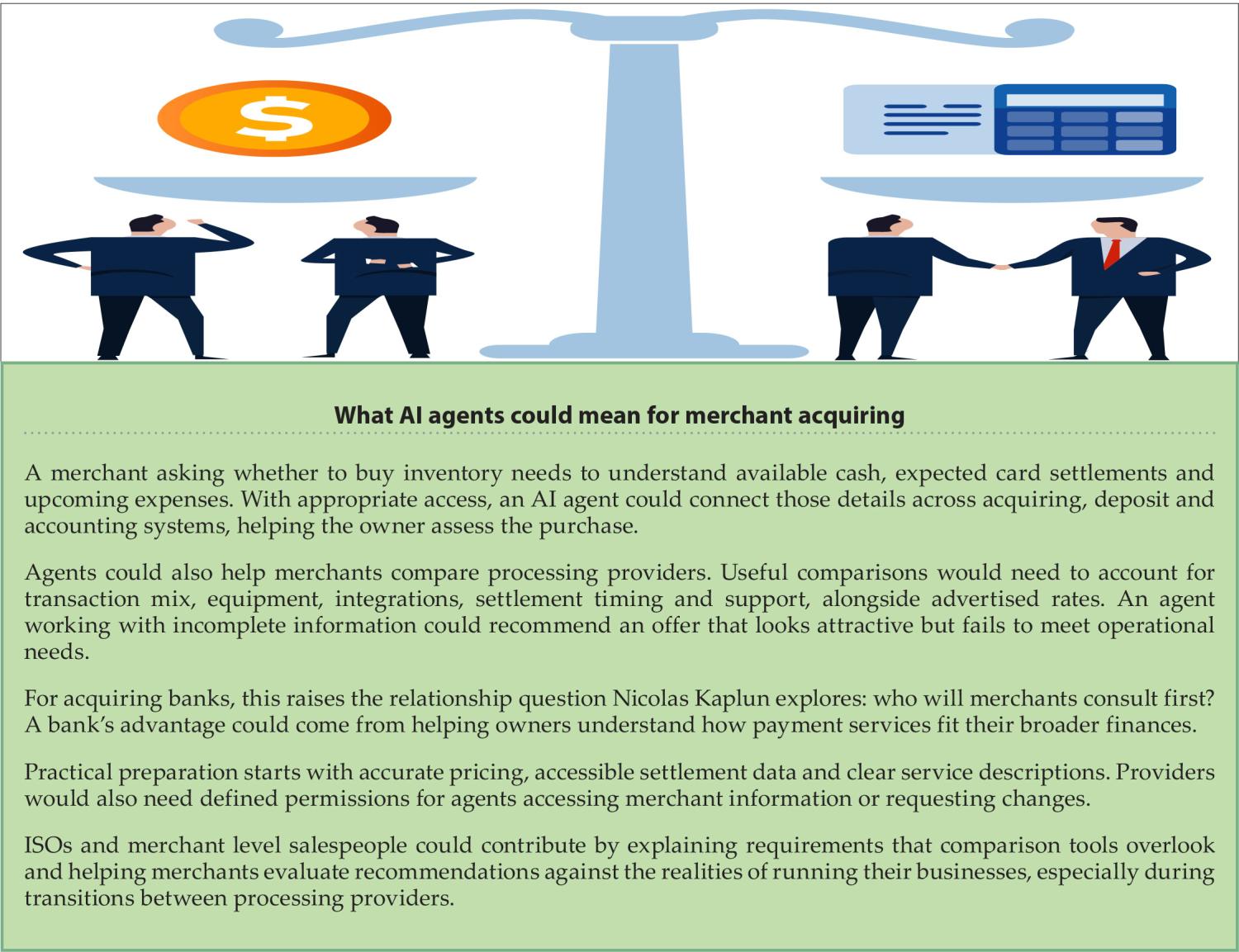
For years, banks have worked to make their customers' lives easier. Branches became websites, websites became apps, and transactions that once required a visit can now be completed in seconds. Each advance has made banking more accessible. But customers still have to bring the pieces together: understand their accounts, compare products and decide what to do with their money.
AI agents introduce a different possibility. Customers will increasingly be able to express a financial goal and ask technology to help achieve it. The implications extend well beyond convenience. If an assistant becomes the starting point for managing money, it could change how people choose financial institutions and where banks create value.
The next competitive challenge for banks is to remain the institution customers turn to for financial guidance, even when an independent AI assistant becomes their starting point. The institution holding a customer's money may not always be the one guiding the customer's decisions.
Consider a simple question: Can I afford a significant expense next month? Today, finding the answer may involve checking several balances, reviewing card payments and estimating upcoming bills. An AI agent with appropriate access could bring that information together and help assess the consequences.
As has always been the case, the customer's starting point is a financial need, rather than a particular account or banking product. AI agents could make it easier to address that need by connecting information and services across products and institutions.
From banking products to financial goals
That change matters because financial institutions have traditionally organized their services around products. Moving beyond that structure has remained a challenge. Savings, credit, payments and investments often have different teams, systems and commercial objectives. Customers experience the consequences of those divisions when they must repeat information or move between services to resolve one financial question.
Agents create a renewed opportunity to redesign that experience around the customer. A person with irregular income, for example, needs to understand how available funds and expected earnings relate to future commitments. An assistant could identify a potential shortfall and explain the available options, combining several products and services to address the customer's needs. Its value would depend on its ability to connect information across those services and make the trade-offs understandable.
The question for banks is how much of that experience they can deliver. A conversational interface can make an existing service easier to use. But the larger opportunity requires rethinking how the bank is organized to serve its customers across products and services.
Who controls the customer relationship?
There is also a question of distribution. If customers begin their financial journeys with an independent assistant, they may spend less time browsing a bank's app or comparing products on its website. The assistant could influence which services they consider. Institutions would then compete for customers whose first interaction happens somewhere else.
This creates a strategic tension for banks. They want to make financial services easier for customers to use, yet allowing independent AI agents to access those services could weaken their direct relationship with the customer. An assistant that compares offers and coordinates financial tasks could become the customer's primary point of contact, while the bank remains the provider behind it.
Restricting access by external agents may help banks preserve that relationship in the short term. But relying on those restrictions could become less effective as technology and regulatory frameworks evolve. Banks will need to consider how to support customers who choose to use independent assistants while continuing to earn their trust and business. Established strengths—including experience, reliability and a recognized brand—remain valuable. To carry those advantages into an agent-mediated experience, banks will need accurate product information, reliable connections with authorized external systems and services that meet customers' financial needs. The competitive challenge is to give customers compelling reasons to choose the bank, even when an assistant helps them evaluate the alternatives.
None of this means that customers will immediately hand over their financial lives to autonomous software. Adoption will depend on the task, the perceived risk and the confidence each person has in the service. Someone may be comfortable receiving a spending summary while wanting direct involvement in any decision about borrowing or investing. Banks should design for that range of expectations.
Why better interfaces aren't enough
The difficulty is that the most visible part of the transformation is also the easiest to misunderstand. An assistant can deliver a convincing answer while relying on incomplete information. A bank may have an advanced interface but still struggle to connect account data, apply product conditions consistently or complete a process across departments. Meeting those expectations requires modernization beyond the interface, reaching into the systems and processes that support the customer experience.
For banks, modernizing legacy systems and fragmented processes remains a bottleneck to broader AI adoption. Disconnected data and inflexible architectures can limit the ability to deploy AI reliably across the organization, including agents that coordinate services across products.
AI itself can support this modernization by helping teams understand legacy software and develop and test changes. Progress also requires clear decisions about which processes to redesign and how employees will work with the technology. Returns will depend on turning individual AI capabilities into improvements that can scale across the bank. Leadership has a central role. If an agent supports a journey spanning several products, responsibility for the customer's experience must extend across those products as well. Otherwise, each department can meet its own objectives while the overall service falls short. The modernization challenge involves investment priorities, incentives and accountability as much as technology.
Trust as a competitive advantage
Trust will be the main source of differentiation. The ability to explain a recommendation matters, whether it comes from a human adviser or an AI agent.
Customers should understand whether the service considers a broad range of options or only the bank's own products.
They should also know when information is insufficient and when a human professional needs to be involved.
This requires an ongoing dialogue among financial institutions, technology providers and regulators. The activities supported by an agent must be assessed against the obligations that apply to them. That dialogue should clarify how responsibilities are shared when an agent accesses financial information, recommends a product or initiates a transaction, and whether additional safeguards are needed to protect customers. Protecting customers and enabling useful innovation are responsibilities that must advance together.
For bank leaders, progress should be measured by how effectively customers can understand their finances and act on their goals. Does the service help them understand the consequences of a financial decision? Can it adapt when circumstances change? Does it reduce the effort required to resolve a problem? Counting interactions with an assistant will say little if the customer still has to reconcile conflicting information or restart the process elsewhere.
The financial services industry has already changed how people access their money. AI agents could change how they manage it and, most importantly, how they choose the institutions they rely on. The banks best positioned for this transition will connect technology with a clearer understanding of customers' financial needs. What is at stake is the relationship at the center of banking: who people turn to when they need to decide what happens to their money. 
Nicolas Kaplun is CEO of the Financial Services AI Studio at Globant, where he oversees global growth, innovation, customer success and technical expertise. Previously, he served as Globant's Chief Business Officer for North America and Latin America. With a background spanning consulting, technology and financial services, Nicolas brings extensive experience in global strategy and business development at the intersection of financial services and technology. Contact him via LinkedIn at linkedin.com/in/nicolas-kaplun-847166.
Notice to readers: These are archived articles. Contact information, links and other details may be out of date. We regret any inconvenience.
