




The Green Sheet Online Edition
March 9, 2026 • 26:03:01
Street Smarts
Are ISOs recruiting agents or ISVs?
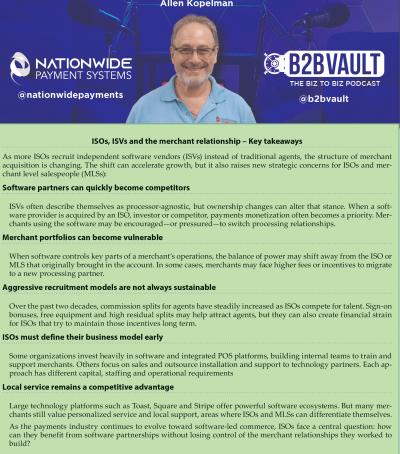
A lot of ISOs these days are trying to recruit ISVs instead of agents. Is this practice sustainable? What happens when the ISV gets acquired by an investor or competitor and starts poaching the merchant portfolios of ISOs and merchant level salespeople (MLSs)?
ISVs may claim to be processor-agnostic, but all bets are off when an ISO or private equity acquires them. The first order of business, after establishing a new business entity, is to monetize payments. This begins by instructing all the merchants in an ISO's portfolio to sign up for processing or face harsh penalties of up to 50 basis points or $400 a month.
These predatory practices are nothing new and have been going on for years. Most merchants end up leaving, and the ISOs and MLSs who worked hard to attract and retain them don't have an extra $100,000 to challenge predators or survive a long-term lawsuit.
Changing business model
When I started in this business in 2001, the going rate for commissions was 50 percent. Over time, as ISOs competed to attract new agents, commissions went up to 70, 80, 90 percent with free terminals and sign-on bonuses. Offers like these are good while they last but hardly sustainable. I've seen some ISO friends start these programs and get in debt up to their eyeballs after only a few months.
- A word of advice for ISOs: Stop recruiting MLSs who want everything for free. They will stick around for a while but only until the next big sign-on bonus comes along. The only ISOs that win at this game are those with tons of cash that are willing to play a long game.
- A word of advice for MLSs: Try on a few different hats and figure out what business model is right for you. Decide what you're going to sell, whether it's terminals or POS or software or software as a subscription service. Don't expect instant results. Residual splits will keep going down until you prove yourself.
The ISO's competitive advantage
It's not easy to win merchants away from Toast, Square and Stripe, because most businesses see the software as more than a tool for accepting payments. They see it as a business management hub with built-in loyalty, accounting, payroll and customer analytics that gives them everything they need to run a business from a single platform.
I agree that software, SaaS and integrated POS systems are great for cultivating long-term merchant relationships. ISOs and MLSs who sell these systems can offer local, personalized service, which gives them a competitive advantage over big tech. Many merchants that use self-service and cloud-based systems miss having local service and support. ISOs and MLSs can fill that gap.
Choose your business model
I see ISOs invest in software that they sell directly through their salaried salesforce. I see other ISOs fail to monetize investments in SaaS and integrated POS systems and go back to selling legacy POS technology. Don't let this happen to you. Decide early on if you want to provide or outsource support and choose your business model wisely.
- Dealer model: ISOs that are dealers do their own training and onboarding, which can be costly and complicated. It takes skill, time and money to install POS systems. MLSs who sell SaaS or high-end POS have to learn the products before they train merchants and their staff. Training alone can take a few days or a week. Margins may be better, but how much time and capital will in-house sales and support require?
- Partner model: ISOs that prefer to move fast and sign new accounts can outsource service and maintenance and focus on making more sales. I would prefer to outsource technology to a knowledgeable partner so that I can focus on what I do best, which is selling and acquiring new accounts. And I only partner with companies that fully own the software and don't look like low-hanging fruit to investors and my competitors.
One ISO recently asked me how they can get agents to sell software when all they want to do is sell terminals. The short answer is to make selling software as easy as selling POS devices, and level up the commissions by giving agents more than a 25 to 50 percent split.
AI-powered software is making it easier for merchants to personalize the customer experience, and adoption is growing. ISOs and MLSs need to catch up. With the right technology partner, we can be dealers that provide programming, installation and support or specialists that consult, refer and sell.
Want to know more? Keep reading The Green Sheet and consider following me on LinkedIn, where we can share ideas and support each other. 
Allen Kopelman, a serial entrepreneur, is co-founder and CEO of Nationwide Payment Systems Inc. and host of B2B Vault: The Biz to Biz podcast. Email him at allen@npsbank.com and connect on LinkedIn https://www.linkedin.com/in/allenkopelman/ and Twitter @AllenKopelman.
Notice to readers: These are archived articles. Contact information, links and other details may be out of date. We regret any inconvenience.
