




The Green Sheet Online Edition
March 9, 2026 • 26:03:01
Illinois interchange law survives court challenge: Networks must prepare for July 1 implementation
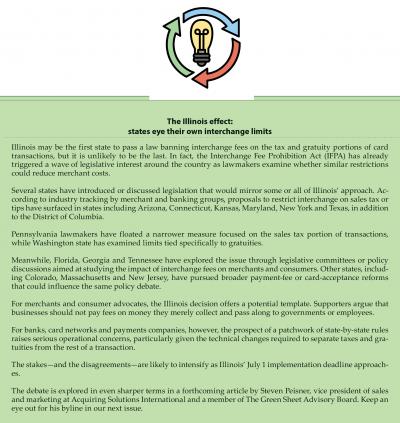
Illinois' Interchange Fee Prohibition Act (IFPA), the first-in-the-nation ban on charging interchange fees on taxes and tips, survived a major legal challenge on Feb. 11, 2026, setting up a July 1, 2026, implementation deadline that will require significant system changes across the payments industry.
However, the same federal court struck down the law's data usage restrictions, creating a split outcome: payment networks must build new infrastructure to exclude taxes and tips from interchange calculations, but can continue using transaction data for fraud prevention, rewards programs and other purposes. The ruling opens the door for similar legislation in 22+ states considering interchange regulations.
What the law does
The Illinois Interchange Fee Prohibition Act does two things:
- Bans interchange on taxes and tips: Starting July 1, card networks, processors, acquirers and issuers cannot charge merchants interchange fees on the tax and gratuity portions of transactions. Merchants must separately identify these amounts in transaction data. If they can't do it in real-time, they have 180 days to submit documentation for reimbursement. Violations will result in $1,000 per transaction.
- Restricts data usage (mostly struck down): The law originally prohibited using transaction data for anything beyond processing the immediate transaction. The court found this violated federal banking law and blocked enforcement against most financial institutions and networks, but the restriction still applies to some out-of-state credit unions and savings institutions.
The court's ruling: Why interchange restrictions survived
Banks and card networks argued that federal banking law prohibits states from regulating interchange fees. Chief Judge Virginia Kendall disagreed, focusing on one critical fact: payment networks set interchange rates, not banks.
"All Parties agree that the Issuers and Acquirers do not set those fees; the Payment Card Networks do," the court wrote. Since networks establish the fee schedules and banks just receive the revenue, the court found Illinois can regulate how those fees are calculated without interfering with federal banking powers.
This matters because previous court decisions protected banks from state laws that directly restricted fees banks themselves charge (like ATM fees). But the court saw interchange differently: it's set by Visa, Mastercard and other networks on behalf of the entire ecosystem.
Impact on revenue
Illinois has roughly 9 percent average sales tax (10.25 percent in Chicago). Add gratuities in restaurants and hospitality, and Illinois' attorney general estimates the law will reduce interchange revenue by 9 to 10 percent on Illinois transactions. The industry argued this could devastate profit margins, but the court said compliance costs alone don't trigger federal preemption.
Implementation challenges: What networks and processors must build
The technical lift is substantial. According to declarations submitted in the case:
- Visa and Mastercard estimated millions of dollars in compliance costs and warned implementation could take "months if not years."
- New data fields must be created to separately capture tax and gratuity amounts.
- Authorization and settlement systems need modification to calculate split-basis interchange.
- Manual processing workflows must be built for merchants who submit tax documentation after the fact (up to 180 days later).
- need systems to match late merchant submissions to specific transactions and process refunds within 30 days.
Networks and processors have less than five months until the July 1 deadline.
The data usage win … with complications
The court blocked enforcement of the data usage restrictions against:
- National banks
- Federal credit unions and savings associations
- Out-of-state state banks
- Payment networks and processors (when supporting the above institutions)
These entities can continue using transaction data for fraud monitoring, rewards programs, dispute resolution, AML compliance and analytics.
But here's the catch: the restriction still applies to out-of-state state-chartered credit unions and some savings institutions. This creates a compliance patchwork where networks must track which institutions are exempt and which aren't.
What happens next
Following are three responses coming as a result the ruling in favor of the IFPA:
- The Illinois Bankers Association announced it will appeal to the Seventh Circuit Court of Appeals. However, there's no automatic stay. Meaning, unless the appeals court intervenes, the law takes effect July 1, 2026.
- To make matters more complicated, 22 states have introduced or previewed interchange legislation. The Illinois Retail Merchants Association called this decision "a model for other states." Expect copycat bills.
- Industry groups are urging the Illinois legislature to repeal the law. The Electronic Payments Coalition called it a "reckless policy" that will "inflict credit card chaos."
What you should do now
If you're a payment network:
- Stand up implementation teams immediately: you have 4.5 months.
- Begin technical design for split-basis interchange calculation.
- Coordinate with acquirers and issuers on the manual submission workflow.
- Monitor the appeal and consider requesting a stay of implementation.
- Track legislation in other states, and evaluate whether uniform standards would reduce future compliance costs.
If you're an acquirer or processor:
- Survey your Illinois merchant base: can their POS systems separately report tax and gratuity?
- Build merchant education programs: many won't be ready by July 1.
- Design processes for handling manual merchant submissions (180-day window).
- Plan for increased merchant support volume around the implementation date.
If you're an issuer:
- Model the revenue impact on your Illinois portfolio (particularly high-tax cities and restaurant/hospitality categories).
- Ensure systems can match late merchant tax documentation to historical transactions.
- Train operations teams on the 30-day reimbursement requirement.
- Prepare customer communications if you adjust fees or benefits to offset revenue loss.
If you're a merchant:
- Verify your POS system can separately report tax and gratuity in transaction data.
- If not, budget for upgrades or prepare to use the manual 180-day submission process.
- Understand that you won't see automatic savings: you must transmit the data correctly.
The bigger picture
This decision fundamentally challenges the assumption that interchange is untouchable by state regulation. By holding that networks, not banks, set the fees, the court opened a path for state-level intervention that the industry didn't think existed.
Whether that path survives appeal is uncertain. But even if Illinois loses on appeal, the July 1 implementation will provide real-world data on whether the payment system can adapt to state-by-state interchange rules. For an industry built on standardization and network effects, that's a stress test nobody wanted.
The clock is ticking. 
An alumnus of the University of San Diego, School of Law, Arzumanyan has a proven track record of drafting, reviewing, revising and negotiating an extensive array of commercial contracts, including vendor, nondisclosure, employment, software-as-a-service, consulting and marketing agreements. Leveraging his prior in-house counsel background, Arzumanyan has also carved out a unique niche within the electronic payments industry as his transactional expertise now encompasses merchant processing, merchant banking and sponsorship, referral, independent sales office, and other related agency agreements. Contact him at larzumanyan@attorneygl.com.
Notice to readers: These are archived articles. Contact information, links and other details may be out of date. We regret any inconvenience.
