




The Green Sheet Online Edition
June 22, 2026 • 26:06:02
The myths of organic versus paid merchant acquisition
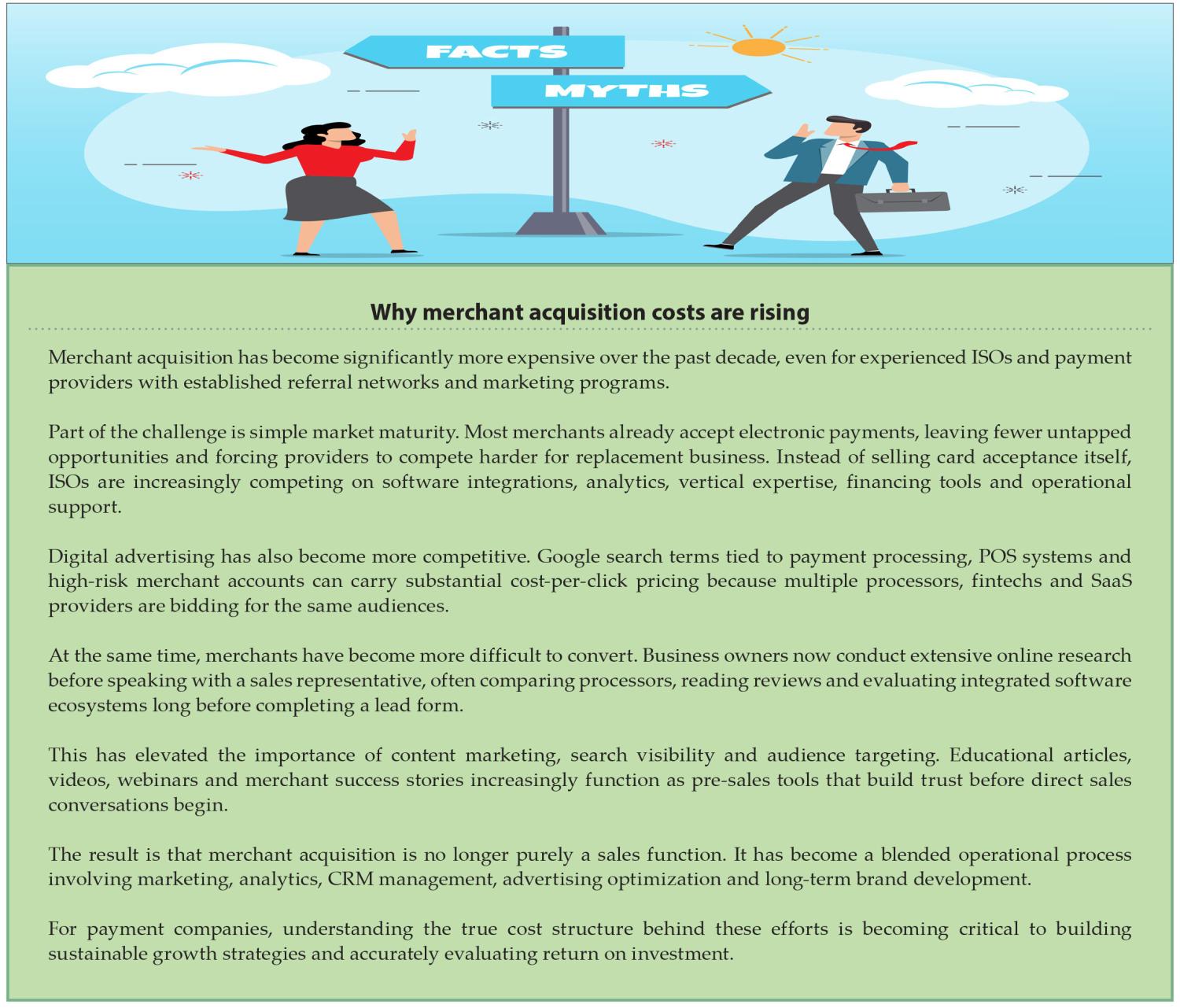
There is a belief embedded in payments marketing culture that organic traffic is essentially free. It shows up in ISO budget presentations, fintech go-to-market decks and merchant acquisition strategy plans. The logic seems airtight: search engine optimization (SEO), social media, industry forum participation, and community-driven content cost nothing to place, ergo they cost nothing to run.
But “no media spend” does not mean “no cost.” In practice, it often means trading dollars for slower, manual execution. For ISOs, merchant level salespeople, payment processors, and fintechs competing for merchant accounts in a crowded market, this framing is not just incomplete. It is actively misleading, and it leads organizations to systematically undercount one of their most significant operating expenses: time.
Time is the hidden line item
The case for organic traffic is compelling on its face. Organic search accounts for more than half of all website traffic globally, and for payment processors and ISOs targeting merchants researching their options, the top-ranking result on Google earns a click-through rate of roughly 27.6 percent (see tinyurl.com/k8vd7ear). These numbers make organic channels look like a bargain. What they do not show is the runway required to get there.
Most payments industry websites take three to six months to see measurable organic results, and competitive verticals—high-risk processing, integrated payments, SaaS-bundled acquiring—often require six to 12 months before rankings translate into meaningful merchant leads. The pages ranking first on Google today are, on average, nearly three years old. That is not a channel. That is a long-term infrastructure investment disguised as a marketing tactic.
For most ISOs and payment companies, especially those in growth mode or launching new value-added service offerings, the people doing the SEO work are not interns. They are content strategists, copywriters, product marketers and in some cases the principals themselves. Their time carries a real cost—often the most expensive resource in the business. When that cost goes untracked because there is no invoice attached to it, organizations make decisions based on a false cost structure, overvaluing "free" channels while ignoring the operational drag of manual execution.
The paid channel misconception
The counterpoint to organic is usually paid advertising, and it carries its own stigma in the payments industry. Paid channels are seen as expensive, unsustainable and blunt—especially for smaller ISOs and independent MLSs without large marketing budgets. These criticisms are fair when applied to poorly constructed campaigns. They are not fair as a general verdict.
Paid search delivers results immediately. Unlike SEO, which requires months of compounding effort before producing a merchant pipeline, a well-built paid campaign can generate qualified merchant leads on day one—critical when launching a new vertical program, entering a new geographic market, or rolling out a new payment technology offering. According to WordStream's 2025 benchmark data, the average cost per lead across Google Ads is $70.11, but this number varies enormously based on campaign execution. In practice, execution is the variable—not the channel itself (see tinyurl.com/5t48s2bz).
The difference between a well-structured paid campaign and a poorly structured one is not marginal. It is often the difference between a channel that produces signed merchant accounts and one that drains budget without return.
Execution is everything. Targeting, bid strategy, creative, landing page alignment and audience segmentation each affect cost-per-merchant-acquisition significantly. But just as important is how quickly those variables are adjusted.
Payment companies that treat paid advertising as a set-it-and-forget-it channel will overpay. Those that actively manage and optimize their campaigns can reduce their cost-per-acquisition substantially, often by more than 70 percent compared to unoptimized baselines.
Waste is the real enemy, not the channel
One of the most overlooked sources of wasted paid spend is audience mismanagement. When payment companies run acquisition campaigns without excluding audiences that will never convert as new merchants—such as existing processing clients, current referral partners and equity investors—they are spending real money to advertise to people who are already inside their ecosystem.
This is not a targeting edge case. It is a structural inefficiency that erodes campaign performance quietly over time.
The fix is straightforward but requires intentional CRM integration. By building exclusion lists from live CRM data and syncing them to ad platforms, payment marketers can ensure that acquisition budget is deployed toward actual merchant prospects. When CRM, ad platforms, and analytics are connected, this becomes a continuous, automated safeguard—not a one-time fix. This practice also protects partner relationships. Showing an existing ISO partner or active merchant an acquisition-stage ad creates confusion and can erode the trust that long-term payment relationships are built on. Precision in audience management is not a technical nicety. It is one of the highest-leverage levers available to any payment company’s paid media program, and it is widely underutilized across the acquiring ecosystem.
A more honest framework for evaluating channels
The organic versus paid debate is a false binary for payment industry marketers. Both channels have legitimate roles in a well-constructed merchant acquisition program. The problem is not which channel a company chooses. The problem is evaluating those channels with incomplete cost inputs. Organic strategies should be assessed against their true fully loaded cost, which includes the labor hours, tool subscriptions, content production and link-building investment required to generate results. Paid strategies should be assessed against the quality of their execution, not the gross spend figure alone.
A useful reframe: organic is a long-term asset play that builds compounding industry authority over years. Paid is a precision tool that delivers measurable merchant leads in real time when operated correctly. Neither is free. Neither is inherently wasteful. Both reward the payment companies that take them seriously enough to run them well.
What this means in practice
Payments industry marketers who want to make better allocation decisions should start by auditing how their organization accounts for the cost of organic channel management. If time is not being tracked, the ROI comparison to paid channels is not valid.
From there, any paid program should be evaluated on the quality of its audience targeting, its exclusion logic, and the degree to which campaigns are being actively managed versus passively monitored. The goal is not more activity, but better, faster and more connected execution.
The payment companies generating the best merchant acquisition results from search in 2026 are not choosing between organic and paid. They are treating them as complementary: using paid channels for immediate, measurable merchant acquisition while building organic presence as a long-term compounding asset that supports brand authority with acquiring banks, software vendors and merchant prospects alike (see tinyurl.com/5t48s2bz).
That is not a new idea. It is simply one that gets obscured whenever someone in a budget meeting calls organic traffic free. 
Joel Horwitz is the CEO of Synter, a technology company focused on agentic AI advertising execution for businesses. To learn more, visit https://www.syntermedia.ai or explore Synter’s videos and product insights on their YouTube channel at https://www.youtube.com/@synter-media-ai. Contact Joel via LinkedIn at linkedin.com/in/joelshorwitz.
Notice to readers: These are archived articles. Contact information, links and other details may be out of date. We regret any inconvenience.
