




The Green Sheet Online Edition
June 22, 2026 • 26:06:02
What your merchant services portfolio is really worth - Part 1
Too many payments ISO owners and agents believe their portfolio is worth more than it is. The ones who find out the hard way are those who walk into a sale or financing conversation without understanding what buyers and lenders actually care about—and it is rarely the number they expect.
The highest residual income does not produce the highest valuation. The most durable, diversified, and well-structured portfolio does.
As merchant portfolios are increasingly evaluated as financial assets—by acquirers, lenders and institutional investors—the factors that drive valuation have become far more nuanced than most ISO owners realize. Gross residual income is a starting point, not a finish line. What matters is the durability, diversification, and structural quality of the revenue stream behind that number.
The challenge is that for most ISOs and agents, portfolio performance is a secondary consideration—if it is a consideration at all. These are sales organizations by nature. The focus is on winning the next account, not on how that account fits into a portfolio strategy.
Drivers of portfolio valuation
In many cases, the concept of portfolio performance does not even enter the conversation until the owner attempts to sell or collateralize their residual for capital, and that is when they discover, often for the first time, what buyers and lenders actually evaluate and what truly drives the value of what they have built.
Over two decades in the merchant acquiring industry—involving analysis of or transactions on more than 250,000 merchant accounts—I have evaluated portfolios ranging from pure low-risk brick-and-mortar books to high-risk specialty processing operations. The differences in how these portfolios are valued—often by factors of 2x to 3x—come down to a handful of measurable characteristics that every ISO owner should understand.
When institutional capital evaluates a merchant portfolio—whether for acquisition, financing or investment—it focuses on six primary factors. These are not theoretical constructs. They are the actual criteria we apply in our portfolio credit analysis work, drawn from real diligence engagements.
1. Attrition: The most critical risk factor
Attrition is the single most important variable in residual stream valuation. It determines how quickly a portfolio's revenue erodes over time, and it is the first metric any serious buyer or lender will examine.
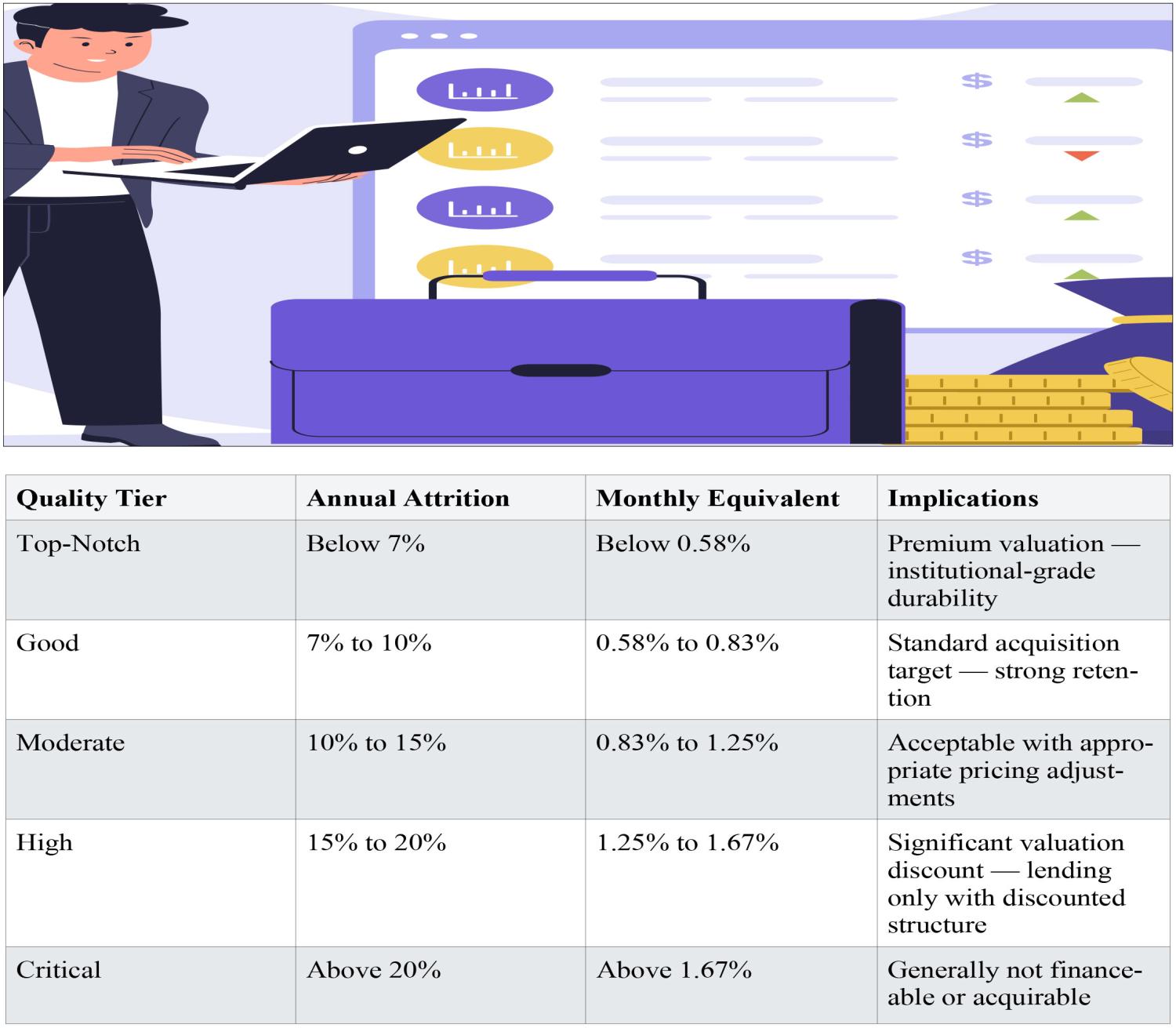
In our experience, portfolio attrition varies dramatically based on merchant quality, industry vertical and servicing infrastructure:
(See attached Table)
An important distinction that many ISO owners overlook: attrition should be measured in both account count and revenue. They are not the same, and both matter. An ISO can lose a significant number of small accounts while retaining its highest-volume merchants—producing low revenue attrition but high account attrition.
Conversely, the loss of a small number of large accounts can produce devastating revenue attrition even when overall account retention looks healthy. Sophisticated buyers and lenders evaluate both dimensions, and the divergence between the two often reveals the real risk profile of a portfolio.
From a buyer's perspective, attrition is the first input into any valuation model. A buyer projecting the future cash flows of a portfolio will discount the purchase price directly based on expected attrition—and if the seller cannot produce clean attrition data, the buyer will assume the worst and price accordingly.
The difference between a portfolio with 8 percent annual attrition and one with 18 percent can represent a 30 percent to 50 percent reduction in what a buyer is willing to pay, because the projected cash flow runway is fundamentally shorter.
We routinely encounter ISOs whose blended attrition rates exceed 20 percent annually, despite the owner's perception that the business is stable. Often, the issue is concentrated in the high-risk merchant segment—where annual churn can run two to three times the portfolio average — dragging overall retention metrics well into the High or Critical range. Many ISO owners are surprised to learn where their portfolio falls when measured rigorously against these thresholds.
Even where formal attrition reporting is unavailable, experienced evaluators can derive attrition from three sources: merchant account start and close dates, month-over-month merchant count changes, and net residual revenue trends. If an ISO cannot produce clean data on any of these three dimensions, that itself is a red flag to capital providers.
If you don't know your attrition rate, you don't truly know what your portfolio is worth.
2. Merchant concentration: The hidden risk
Concentration risk takes multiple forms, and each one can materially reduce portfolio value. Revenue concentration is the most straightforward. When a small number of merchants generate a disproportionate share of residual income, the loss of any single account creates outsized revenue impact.
It is not uncommon for the top 10 or 25 merchant accounts in an ISO portfolio to generate 20 percent to 30 percent or more of total residual revenue—and for the top 10 percent of accounts to generate well over half. When the average residual per account is heavily weighted toward a small number of high-volume merchants, the loss of even one or two accounts can have a material impact on the portfolio's value.
The institutional benchmark we apply: top 10 merchants should represent less than 15 percent of total residual revenue, and the top 10 percent should represent less than 50 percent. ISOs and agents should track these metrics actively—not just during a sale or financing event, but as an ongoing portfolio management discipline.
When a portfolio exceeds these thresholds, buyers and lenders adjust their valuation downward—sometimes significantly. A buyer looking at a portfolio where the top 10 accounts represent 25 percent or more of revenue will immediately model a stress scenario: what happens if two or three of those accounts leave?
If the answer materially impairs the residual stream, the buyer will either reduce the upfront price, increase the earnout component to shift that risk back to the seller, or walk away entirely.
Industry vertical concentration is equally important. Certain industries produce strong residual income but carry elevated compliance risk, regulatory scrutiny and processing volatility. Tobacco and vape retailers, nutraceutical companies, travel agencies, firearms dealers and CBD merchants can generate attractive per-merchant revenue—but they also expose the portfolio to sudden processor termination, sponsor bank exits and regulatory action.
We have evaluated ISOs where a single high-risk industry vertical accounted for more than a quarter of total portfolio net income. Despite generating above-average revenue per merchant, that level of concentration creates a structural vulnerability: if the sponsor bank or processor exits that vertical—which happens with increasing frequency in the current regulatory environment—a significant portion of the portfolio's income is immediately at risk.
From the buyer's perspective, vertical concentration is not just a risk factor—it can be a deal-killer. A buyer who acquires a portfolio with 25 percent to 30 percent of revenue in a single high-risk vertical is inheriting a regulatory liability that they may not be able to insure against. Many acquirers will simply exclude high-risk verticals from the purchase entirely—buying only the low-risk portion of the book—which means the seller receives value on only a fraction of what they thought they were selling.
Geographic concentration is often overlooked but equally material. Portfolios clustered in a single metro area or region are vulnerable to localized economic disruption, competitive displacement by a single aggressive competitor, or targeted agent poaching. Nationally diversified portfolios carry meaningfully lower risk profiles.
3. Revenue per merchant: Quality over quantity
Not all merchants are created equal from a portfolio economics perspective. In our cross-portfolio analysis, average net residual revenue per merchant varies dramatically—from as low as $111 per month in high-risk specialty portfolios to over $600 per month in well-curated low-risk books.
The cross-portfolio benchmark we observe is approximately $288 per month across all active merchants, or roughly $436 per month when measured against processing merchants only.
Lower-volume merchants—those processing under $15,000 per month—tend to have higher churn rates, weaker business fundamentals and lower lifetime value. Higher-volume merchants processing $50,000 or more per month typically represent established businesses with longer operating histories and stronger retention characteristics.
This creates a counterintuitive dynamic: a portfolio of 500 high-quality merchants processing $75,000 per month each may be worth significantly more than a portfolio of 2,000 merchants processing $10,000 per month each, even if the total residual income is similar. The first portfolio has lower attrition risk, lower servicing costs and higher revenue durability—all factors that increase valuation multiples.
Buyers understand this math intuitively. When evaluating two portfolios with identical gross residuals, a buyer will pay a premium for the one with fewer, higher-quality merchants—because the cost to service those accounts is lower, the expected retention is higher, and the revenue per merchant provides a larger cushion against natural attrition.
The portfolio with thousands of low-volume accounts may look impressive on a merchant count basis, but a buyer sees higher servicing costs, higher churn risk and a thinner margin of safety on every account.
4. Agent compensation structure: The margin compression problem
One of the most frequently underestimated risks in ISO portfolio valuation is the agent compensation structure.
Across our advisory engagements, we consistently observe agent payout ratios trending upward—in some cases rising by several percentage points within a single year. When agent costs begin consuming 40 percent to 50 percent or more of gross revenue, the net residual available to the ISO owner—and by extension, to any buyer or lender—is substantially reduced. This compression is one of the reasons the industry is shifting toward W-2 internal sales teams and technology-integrated distribution models, which allow ISOs to control more of the economics while maintaining quality and underwriting discipline.
Beyond the margin impact, agent compensation structures also affect transaction flexibility. Agreements that lack buyout provisions, performance minimums or sunset clauses can create significant friction in any sale or financing event—because the buyer or lender must underwrite the net-of-agent residual, not the gross.
From the buyer's side, agent economics are often the first thing modeled after gross residual. A buyer will calculate the net residual after all agent splits and then apply their valuation multiple to that net number—not the gross. If agent payouts consume 45 percent or more of gross revenue, the buyer is effectively paying a premium multiple on a much smaller income stream.
Worse, if those agent agreements are non-terminable and non-negotiable, the buyer has inherited a fixed cost structure they cannot optimize. This is one of the most common reasons that sellers are disappointed by the offers they receive—they are thinking in gross residual terms, while the buyer is pricing net-of-agent economics.
ISO owners building portfolios with an eye toward future liquidity should think carefully about how their current agent agreements will be viewed by the other side of the table when that day comes. More importantly, there are practical steps ISOs can take now to move the needle on compensation economics without losing their ability to attract and retain productive agents:
- Expand the product suite beyond payments-only. When an ISO can offer agents the ability to earn commissions on POS equipment leasing, merchant cash advances, working capital products or other value-added services, the total compensation opportunity increases without inflating the residual split. Agents earn more in aggregate, and the ISO preserves more of the residual economics that drive portfolio valuation.
- Structure new agent agreements with a reasonable buyout clause from the outset. The goal is not to eliminate agent compensation—it is to create a defined mechanism that gives the ISO flexibility in a future capital event. A well-structured buyout provision, paired with an attractive upfront commission and competitive residual split, creates an agreement that agents will accept and that buyers will not penalize. The key is building this into the agreement from Day 1, not trying to retrofit it years later when the ISO is already in a sale process.
- Consider blended compensation models that combine competitive upfront bonuses with moderate residual splits, rather than low upfront and high residual. This reduces the long-term cost embedded in the portfolio while still giving agents an attractive total earning opportunity on every deal.
The ISOs that approach agent compensation as a portfolio strategy, not just a recruiting tool, will find themselves with meaningfully more flexibility and higher valuations when a capital event arrives.
5. Technology entrenchment: The stickiness factor
One of the most overlooked—and most powerful—drivers of portfolio valuation is the technology that has been placed with the merchant.
There is a fundamental difference between a merchant who was given a free terminal or a lightweight card reader and a merchant who has invested in a full point-of-sale system that runs their entire operation. The first merchant can be moved by any competitor with a better rate and a new terminal. The second merchant is entrenched. They are running their accounting, inventory management, marketing, employee scheduling, ticketing, customer loyalty programs and reporting through that POS system.
Switching processors means switching their entire business infrastructure, and very few merchants are willing to do that over a marginal pricing difference.
ISOs and agents that consistently place full POS systems—and ensure those merchants are actively using the technology beyond basic payment processing—build portfolios with significantly lower attrition and significantly higher valuations. The ability to demonstrate that your merchants are deeply integrated into the technology you sold them is one of the clearest signals of portfolio durability that a buyer or lender can evaluate.
Conversely, portfolios built primarily on free terminal placements or basic processing-only setups carry inherently higher churn risk. Those merchants have no switching cost. If a competitor offers a lower rate or a better signing bonus, the merchant can move with virtually no friction. Buyers recognize this immediately and price it into their offer.
From a buyer's perspective, technology entrenchment is one of the strongest predictors of future retention. A portfolio where 60 percent to 70 percent of merchants are running integrated POS systems is a fundamentally different asset than one where the same percentage are processing on free-placed terminals—even if the current residual income is identical. The first portfolio has a built-in retention moat. The second is one aggressive competitor away from significant attrition.
For ISO owners, the takeaway is clear: selling a quality technology product and ensuring merchants adopt it fully is not just a sales strategy; it is a portfolio strategy that directly translates into higher valuation when the time comes to sell or finance.
6. Processor relationship diversity
The final major valuation driver is the ISO's relationship with its acquiring processors and sponsor banks.
ISOs that maintain relationships with multiple processors—for example, both Fiserv and TSYS platforms—carry lower structural risk than those dependent on a single processor. If one processor terminates the relationship, raises fees or imposes new restrictions, the ISO with multiple relationships can migrate merchants to an alternative platform. The ISO with a single relationship has no fallback.
In the current regulatory environment, this risk is not theoretical. We have directly observed situations where an ISO's primary sponsor bank came under federal regulatory action—specifically an FDIC consent order targeting its ISO program—creating immediate uncertainty for every ISO in that bank's portfolio. ISOs with alternative processor relationships were able to continue operating; those without were left scrambling.
Multi-processor structures are viewed as a valuation positive by sophisticated buyers and lenders. They demonstrate operational maturity, reduce concentration risk and provide business continuity in an environment where processor and banking relationships are subject to increasing regulatory scrutiny.
For a buyer, processor diversity also affects integration planning. Acquiring a portfolio that runs across multiple platforms gives the buyer optionality—they can consolidate merchants onto their preferred processor over time, or maintain the diversification as a risk management strategy.
A single-processor portfolio, by contrast, creates a binary dependency: if anything goes wrong with that one relationship, the entire acquired asset is at risk. Buyers price this accordingly—either through a lower multiple or by structuring a larger earnout to protect against the downside.
Part 2 of this series will explore how real-world portfolio transactions are structured and valued today—from run-off and go-forward deals to aggregation premiums, earnouts and institutional buyer expectations. 
Editorial Note: This is the first installment of a two-part series on what drives portfolio valuation and how merchant portfolios are being valued today. The second article will appear in a subsequent issue.
George Csahiouni is the managing principal of Tripoli Advisors, a payments industry advisory and capital markets firm based in Scottsdale, Arizona. With 20 years of experience in the merchant acquiring industry and involvement in over $1 billion in transactions and analysis, George advises ISOs, fintech platforms and institutional investors on portfolio strategy, operational optimization and capital markets. For more information, visit tripoliadvisors.com. Contact George via LinkedIn at linkedin.com/in/george-csahiouni.
Notice to readers: These are archived articles. Contact information, links and other details may be out of date. We regret any inconvenience.
