




The Green Sheet Online Edition
June 22, 2026 • 26:06:02
From the floor of Money20/20 Europe 2026 The checkout is now the front line of payments compliance
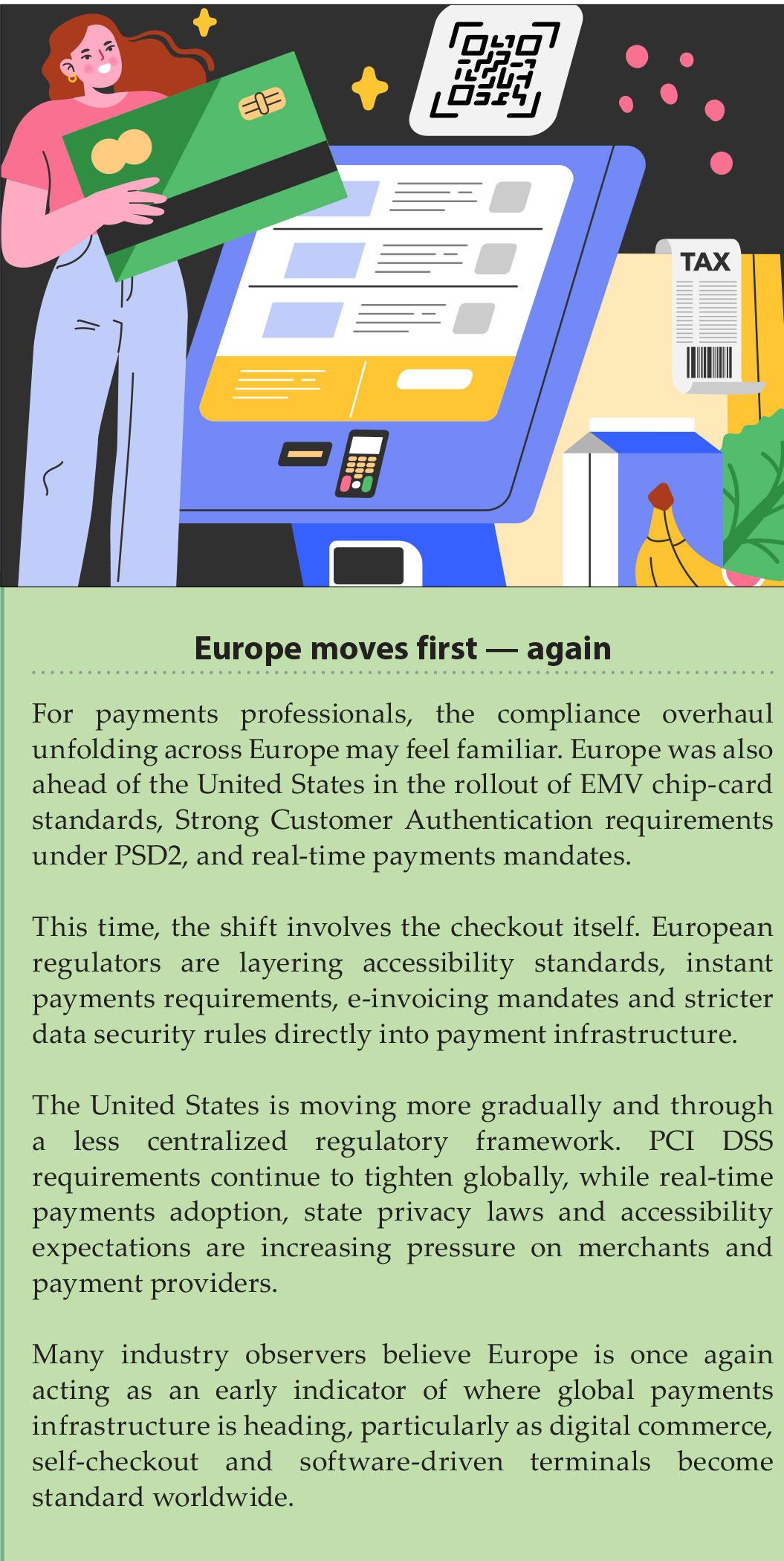
Walking the floor at Money20/20 Europe 2026 in Amsterdam, one theme surfaced repeatedly in conversations with retailers, acquirers and payment infrastructure providers: regulatory pressure is arriving faster than the infrastructure built to absorb it.
This isn't new, but what struck me in Amsterdam was how concretely that pressure has landed, not in the back office, not in compliance teams, but right at the point of sale. The checkout has quietly become the most regulated piece of real estate in retail.
Legislative compliance is no longer a post-transaction consideration. It begins the moment a customer reaches the terminal. Security, accessibility, tax reporting, instant settlement. These are concurrent requirements baked into the transaction itself. And a significant proportion of European merchants are not yet equipped for what is already in force, let alone what is coming.
A collision of mandates is reshaping POS infrastructure
The data Castles Technology published earlier this year in our Germany at the Checkout: POS Outlook 2026 report tells part of that story (see tinyurl.com/2ad2avak). Eighty percent of German retailers plan to overhaul their checkout hardware within two years, and half expect full POS software replacement.
Germany is the largest retail market in Europe, and its merchants are not known for rushing decisions. When they are moving this fast, it is worth asking why.
The answer is a collision of mandates arriving at the same time. PCI DSS v4.0 is now in force, raising the bar on how payment data is handled at the terminal (see www.pcisecuritystandards.org). The EU Accessibility Act comes into effect in June, requiring that payment interfaces be usable by people with disabilities, a requirement that eliminates a significant proportion of legacy hardware (see tinyurl.com/3uzc5whr).
National e-invoicing mandates, advancing toward a European standard, mean that the terminal increasingly needs to capture and transmit structured transaction data in real time. And the Instant Payments Regulation, which reached its first major reporting deadline in April, is making real-time account-to-account settlement a standard expectation rather than a premium option.
Each of these individually would represent a meaningful infrastructure project. Together, they represent a transformation of what a payment terminal actually has to do.
Legacy Terminal Estates Are Becoming a Liability
Merchants who have already upgraded to modern Android-based POS platforms are navigating this transition with relative confidence. Their systems are software-driven, remotely updatable, and architected to carry compliance workloads alongside commercial ones.
Merchants running on legacy proprietary hardware are in a different position. Many of those systems cannot be updated to meet the new requirements. They need replacing, and the window for planning that replacement in an orderly way is narrowing.
Crucially, the same infrastructure investments supporting compliance are also enabling faster software deployment, integrated loyalty, real-time analytics and more flexible payment acceptance. This is a strategic modernization that pays dividends well beyond the regulatory checkbox.
The conversations I had in Amsterdam reinforced this. There is a genuine and growing appetite from the industry, not just for analysis of what regulation requires, but for practical guidance on how it lands in hardware and software terms. That is increasingly where terminal providers and payment infrastructure partners are focusing investment, and it was encouraging to find that appetite as strong as it was at this year's event.
Self-checkout is intensifying the compliance challenge
One finding from our Germany research stayed with me throughout the week. Self-checkout installations in Germany more than doubled between 2023 and 2025 (see tinyurl.com/5x8rkk9y). One in every 18 checkouts is now self-service. That is a significant shift in how transactions happen, and it concentrates the compliance challenge considerably.
A staffed till has a human in the loop but a self-checkout terminal does not. The terminal carries the full weight of accessibility requirements, fraud prevention, receipt compliance and payment verification, autonomously, for every transaction.
That is the environment European retail is building toward. The merchants best placed to thrive in it are those treating this compliance cycle not as a burden to manage, but as an opportunity to put the right infrastructure in place. Infrastructure that can evolve with whatever comes next.
Compliance modernization is becoming a competitive advantage
PSD3 is still working its way through the legislative process, the EU digital identity framework is advancing and the regulatory pressure on the checkout is building. The merchants and technology partners who recognize that and act now will be in a materially stronger position than those who wait for certainty before moving.
If Money20/20 Europe confirmed anything for me this year, it was that the industry understands this. The question is whether the urgency of that understanding is translating fast enough into action at the point of sale. 
Jean-Philippe Niedergang, acting group CEO/EMEA-PACIFIC-LATAM CEO at Castles Technology, brings more than 30 years of leadership experience in the payments, IT and telecommunications industries, including over two decades in payments. He is responsible for driving strategic growth and strengthening Castles Technology's global presence while leading operations across three key regions. Jean-Philippe focuses on expanding the company's footprint, advancing omnichannel payment strategies and improving operational efficiency to meet evolving customer and partner needs. Castles Technology is a global provider of Android-based payment acceptance solutions serving banks, merchants, fintechs, acquirers, ISVs and PSPs worldwide. For more information, visit www.castlestech.com. Jean-Philippe can be reached via LinkedIn at linkedin.com/in/jean-philippe-niedergang-51a442.
Notice to readers: These are archived articles. Contact information, links and other details may be out of date. We regret any inconvenience.
