




The Green Sheet Online Edition
July 27, 2026 • 26:07:02
What your merchant services portfolio is really worth - Part 2
In the first article of this two-part series, I discussed several factors shaping merchant portfolio valuations, including attrition, merchant concentration risk, revenue per merchant, agent compensation, technology entrenchment and processor relationship diversity. This installment explains how portfolios are currently being valued. Portfolio valuations in today's market are typically expressed as multiples of monthly net residual income, adjusted for the quality factors described in Part 1 of this series. If you want to review that article, you'll find it in The Green Sheet issue 26:06:02 at www.greensheet.com/emagazine.php?article_id=8232.
Most ISO owners and agents think in terms of monthly multiples—"my portfolio is worth 24x"—so that is how I will frame it here.An important clarification: the valuation ranges that follow reflect the realistic market for individual agent portfolios and small to midsize ISO portfolios—the types of books that are most commonly bought, sold and financed in the merchant services ecosystem. These are not the same multiples that large FSPs (Fiserv Service Providers), wholesale ISOs, or aggregated platforms command. Agents and ISO owners frequently hear about headline multiples of 40x, 50x or higher and assume that is what their portfolio should be worth, but those numbers are typically achieved through aggregation, institutional scale, diversified infrastructure and multi-year track records that individual agents and small ISOs have not yet built. Understanding where your portfolio sits in the market, not where the largest platforms sit, is the starting point for any realistic valuation conversation.
In practice, valuations fall into three scenarios depending on the transaction structure: a static run-off sale (no future originations included), a go-forward sale (seller continues originating new merchants exclusively for the buyer), and a hybrid structure that falls somewhere in between.
Static run-off sale
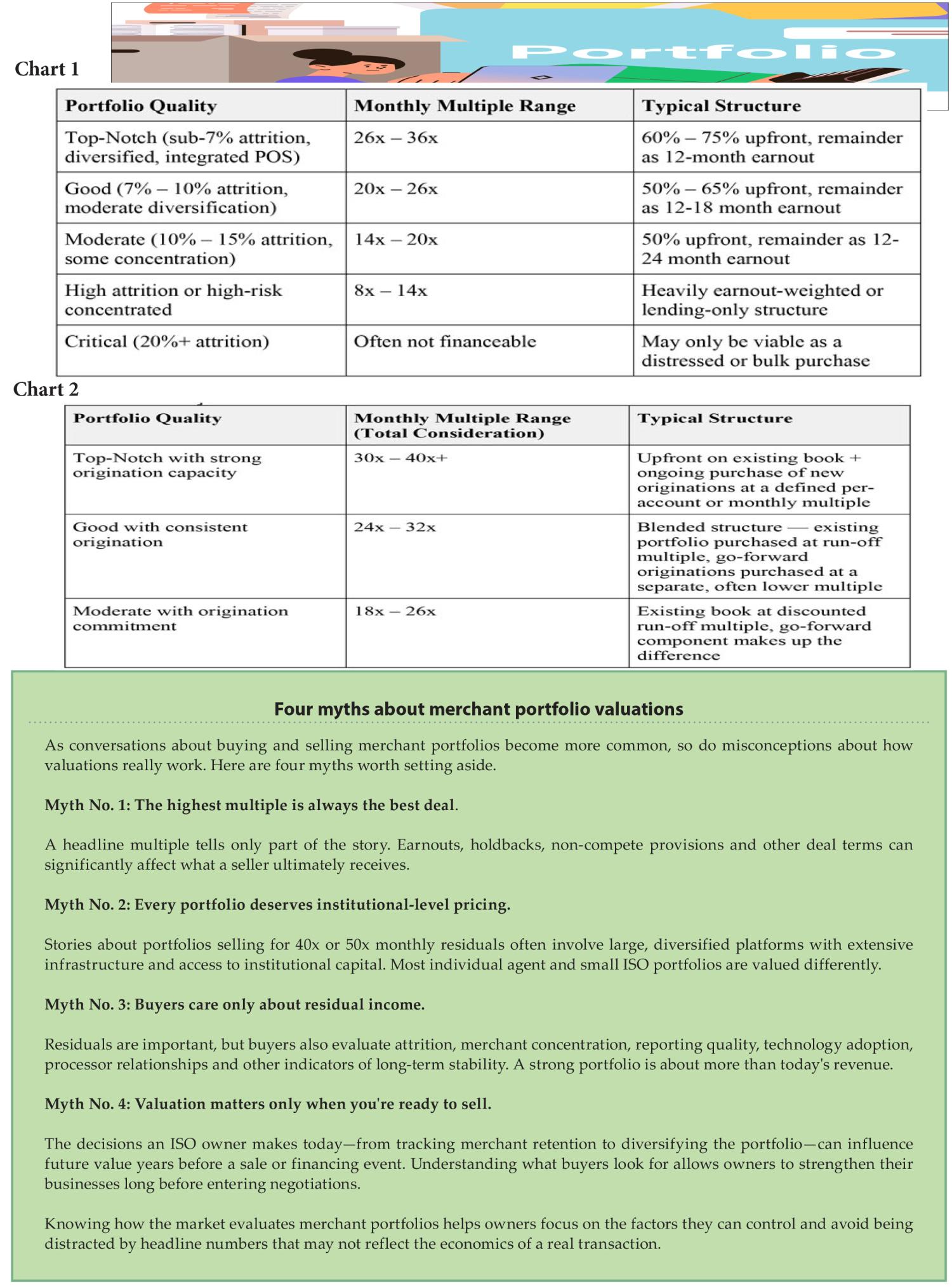
In a run-off scenario, the buyer is acquiring the existing portfolio as-is with no expectation of future originations from the seller. The buyer is underwriting the current residual stream and projecting it forward with an attrition discount. This is the most conservative scenario, and valuations reflect that:
See Attached Chart 1
It is worth noting that anomalies exist on both ends of the spectrum. Exceptional portfolios—those with institutional-grade infrastructure, deeply entrenched technology, minimal attrition and a strategic fit with the right acquirer—have traded at 40x to 50x monthly residual or higher in the right circumstances.
These are not typical transactions, but they do occur when the portfolio quality, the buyer's strategic objectives, and the partnership structure align. On the other end, portfolios with undisclosed risk, poor data quality, or structural issues have traded well below the ranges shown here. The table above represents the realistic market for the majority of transactions.
Go-forward sale
In a go-forward scenario, the seller agrees to continue originating new merchants exclusively for the buyer over a defined period—typically 12 to 36 months. This is significantly more valuable to the buyer because they are acquiring not just a portfolio but a producing origination channel. Go-forward structures can command meaningfully higher total multiples because the buyer is paying a premium for future revenue that has not yet been originated:
See Attached Chart 2
The go-forward component is particularly valuable because it provides the buyer with a built-in origination channel at a known cost, but the seller should understand that the premium multiple on a go-forward deal reflects future residuals the seller is giving up. In exchange, the seller receives more liquidity upfront than a static run-off would provide. This trade-off makes sense for sellers who prioritize immediate capital over long-term residual ownership.
Hybrid structures
Most real-world transactions fall somewhere between a pure run-off and a full go-forward. A seller might agree to a 12-month non-compete with a right of first refusal on new originations, or commit to a limited go-forward period. Hybrid structures allow both parties to manage risk while optimizing total value. The multiples in a hybrid scenario typically fall between the run-off and go-forward ranges shown above, depending on the specific terms negotiated.
What drives a portfolio toward the top or bottom of these ranges?
Within any scenario, the six valuation drivers outlined previously determine where a specific portfolio lands. A top-notch portfolio at the high end of the run-off range will have low attrition measured in both accounts and revenue, minimal concentration risk, strong revenue per merchant, controlled agent economics, deeply entrenched POS technology and multi-processor relationships. A portfolio at the low end will be deficient in several of these areas, and the buyer will price every deficiency into the offer. Portfolios with elevated risk concentrations, weak infrastructure or problematic agent agreements trade at the bottom of their quality tier, and some are simply not financeable at any multiple.
A word of caution on inflated offers. As noted above, multiples of 40x or higher do exist, but they are achieved through exceptional portfolio quality, strategic alignment and institutional-grade infrastructure. ISO owners and agents should be skeptical of unsolicited acquisition offers that cite headline multiples of 50x, 60x or higher without a credible platform, track record or institutional capital structure behind them. In many cases, these offers are designed to attract sellers into a negotiation where the actual economics—after earnout conditions, holdbacks and performance clawbacks—deliver far less than the headline suggests. The institutional capital that funds most portfolio acquisitions operates on 24- to 36-month facility terms, which naturally constrains what an acquirer can pay.
If an offer seems too good to be true, it probably is. The real economics will almost always look very different by the time final terms are negotiated. For sellers seeking to maximize total value, the optimal structure is typically a strong upfront cash component combined with a structured earnout that also provides tax deferral benefits. Working with an experienced adviser who understands both the buy-side and sell-side economics of these transactions can make a meaningful difference in the outcome.
The aggregation premium: Why consolidation creates value
One of the most powerful dynamics in the current market is the aggregation premium. When individual ISO portfolios are combined into a diversified, institutionally managed platform, the resulting entity is worth meaningfully more than the sum of its parts.
Strategic buyers—larger ISOs, payment processors, private equity platforms and fintech acquirers—assign higher valuations to diversified platforms because the risk is lower, the infrastructure costs are spread across a larger asset base, and the combined scale attracts higher-quality capital at lower costs.
This dynamic is one of the primary economic drivers behind the consolidation trend described in "The Great Payments ISO Consolidation" (see tinyurl.com/4tpyzp3u). Well-capitalized platforms that can acquire and aggregate individual portfolios will continue to drive M&A activity across the ISO landscape, and the valuations those sellers receive will be determined by the portfolio quality factors outlined in this article.
What ISO owners should do now
For ISO owners who are not planning to sell in the near term, the framework above still matters because the actions taken today and described below directly influence the portfolio's value in any future capital event.
- Measure your attrition. If you cannot produce clean merchant retention data by month, start tracking it now. Every acquirer and lender will ask for it, and the inability to produce it will reduce your valuation before negotiations even begin.
- Evaluate your concentration. Run the numbers on your top 10 merchants, your top 10 percent of merchants, and your industry vertical exposure. If any single SIC code represents more than 15 percent to 20 percent of your net income, you have a concentration risk that should be addressed through diversified merchant acquisition.
- Review your agent agreements. Understand the long-term cost structure of your agent compensation. If your payout ratios are trending upward or your agreements lack buyout provisions, consider restructuring future agreements to preserve flexibility.
- Diversify your processor relationships. If you operate with a single processor, explore adding a second platform. The operational complexity is modest compared to the risk mitigation and valuation benefit.
- Build institutional-grade reporting. Capital providers expect clean financials, documented processes and transparent reporting. The infrastructure gap between how most ISOs operate and what institutional capital requires is one of the most underestimated obstacles in the industry today—and one that every ISO owner should address before it becomes a barrier.

George Csahiouni is the managing principal of Tripoli Advisors, a payments industry advisory and capital markets firm based in Scottsdale, Arizona. With 20 years of experience in the merchant acquiring industry and involvement in over $1 billion in transactions and analysis, George advises ISOs, fintech platforms and institutional investors on portfolio strategy, operational optimization and capital markets. For more information, visit tripoliadvisors.com. Contact George via LinkedIn at linkedin.com/in/george-csahiouni.
Notice to readers: These are archived articles. Contact information, links and other details may be out of date. We regret any inconvenience.
