




The Green Sheet Online Edition
July 27, 2026 • 26:07:02
When AI pricing becomes a payments operations challenge
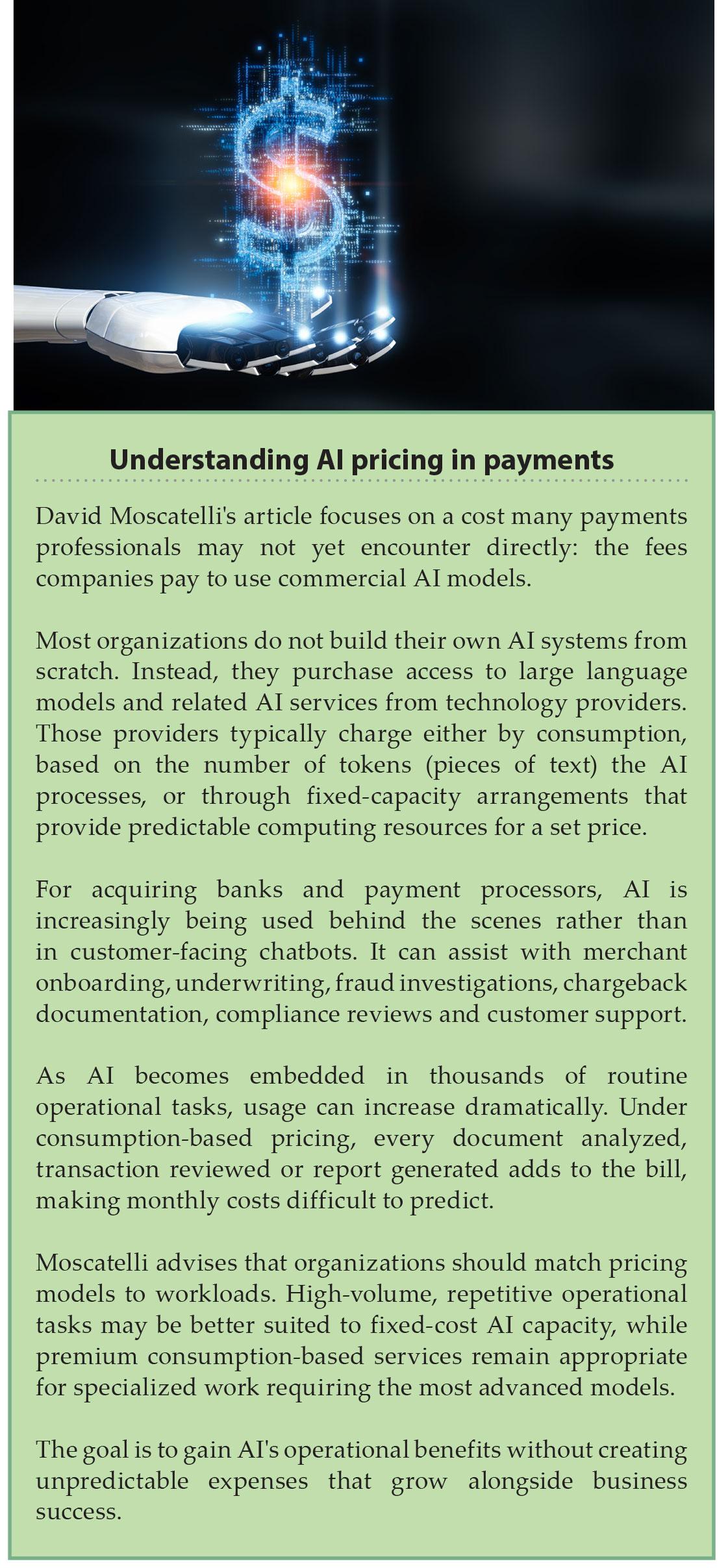
Acquiring banks and processing organizations live in a world of volume, risk, margin pressure and service-level expectations. They are designed to support merchant growth while managing a complex web of fraud risks, card network rules, regulatory obligations, bank partner expectations and operational costs. Payment companies already handle enough unpredictable moving parts; AI pricing should not become another variable they cannot forecast.
AI pricing tends to look quite manageable as long as it stays within a controlled pilot program. But the economics change when it expands into the routine daily work of merchant onboarding, underwriting, fraud review, chargebacks, compliance, support and portfolio monitoring. Once AI starts touching those workflows, consumption-based pricing becomes part of the operating economics.
During early testing, consumption-based pricing can appear easy to control. A small team asks a limited set of questions; the use case is narrow. Once fully integrated, though, production works on a different level. While a merchant-risk review, chargeback packet or compliance question appears to the user as a single task, the AI is likely reading multiple documents, pulling records, summarizing evidence, and moving through several reasoning steps behind the scenes.
Cost profiles change with workflows
That is the awkward part of token pricing in payments: volume does not always translate into a clean, predictable cost curve. The cost profile changes with the workflow. One workflow might start as a simple chat interface but then become embedded automation. Another workflow could start with a customer support team and then radiate across underwriting, risk, servicing and portfolio operations. This is where economics starts to have more impact. If token spend grows faster than user count, agentic workflows are deployed in production, or AI moves from basic chat into merchant-facing or risk-related automation, the organization crosses into a whole new cost category.
The risk is not that AI costs rise but rather that the most useful AI workflows are the ones most likely to become high-volume, repeatable and expensive under the wrong pricing model. The more useful the workflow becomes, the harder it will be to predict its cost. This is not an encouraging incentive for acquiring banks and processors
Payments organizations need AI for daily tasks to improve speed, consistency and decision support. Merchant onboarding, underwriting support, compliance review, chargeback documentation, support triage and portfolio analysis are all logical candidates. And these regular tasks are also exactly the kinds of workflows where repeatability, volume and operating cost shouldn’t be throttled.
Fixed-cost capacity versus premium metered access
The practical answer is not to meter everything forever but to decide which work actually belongs on fixed-cost capacity and which work calls for premium metered access. One feasible structure is an 80/20 model: fixed-cost capacity for the repeatable, economically sensitive workloads that make up most day-to-day AI use, with metered access reserved for the smaller set of specialized use cases where the most advanced model performance justifies premium pricing.
That framework is especially relevant to acquiring and processing because much of the work is repetitive yet highly consequential. A processor is reviewing similar merchant records thousands of times. A risk team continually evaluates patterns across support tickets, transaction histories and onboarding files. A compliance team needs fast access to documentation that already exists inside the organization. None of these workflows are occasional novelty tasks; they’re essential, and they are regular occurrences.
Fixed-cost capacity changes the economics because spend is tied to the infrastructure rather than to per-token output. Depending on the organization’s risk profile and workload, this could mean on-premise or provisioned AI infrastructure for high-volume use cases where cost predictability and data control are prime considerations. Once the platform is in place, more users, queries and workflows are spread across the same capacity, and the effective cost per interaction falls as usage grows. That is the opposite of the success penalty built into many consumption models.
Payments leaders do not need to abandon variable-cost AI. What they do need is a fixed-cost alternative for high-volume, repeatable workloads where predictable costs are more important than squeezing out slightly better model performance. Acquiring banks and processors will keep using AI because the operational need is real. The question is whether the pricing model supports scale or punishes it. The strongest AI strategies will help payments organizations support more merchants, review risk faster and scale operations without turning every successful workflow into a new cost surprise.
David Moscatelli, CEO and founder of Go Abacus, is a payments and technology leader specializing in analytics, machine learning and enterprise AI. He was the innovator behind Deloitte Cortex and previously led software innovation at Deloitte and Synchrony Bank. As co-founder and CEO of Go Abacus, he drives product strategy and infrastructure development focused on secure, compliant AI deployment for regulated industries. Based in Chicago, the company provides on-prem AI infrastructure that enables financial institutions, healthcare organizations and insurers to deploy AI within existing systems while maintaining strict control, auditability and regulatory readiness. For more information or connect with David, please visit https://goabacus.co or email info@goabacus.co.
Notice to readers: These are archived articles. Contact information, links and other details may be out of date. We regret any inconvenience.
